Private AI models
Private AI models are the center of Nexus: plug in self-hosted or partner-hosted Private AI, then wrap it in an organizationally aware package — tools, channels, ranking, and Diode connectivity — so the model your policy allows can actually work on confidential data.
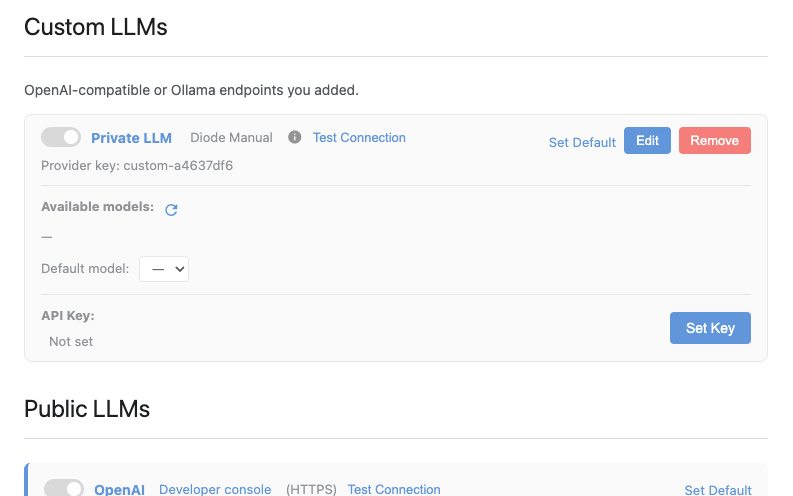
What “Private AI” means here
| Source | Examples | Where it shows up |
|---|---|---|
| Self-hosted | Ollama, vLLM, other OpenAI-compatible APIs in your VPC, plant, or region | Settings → LLMs → Custom LLMs |
| Partner-hosted Private AI | A managed private endpoint your MSP or AI partner operates for you | Same Custom LLMs path — OpenAI-compatible URL + credentials |
| Public cloud LLMs (optional) | OpenAI, Anthropic, Perplexity, … | Settings → LLMs → Public LLMs — useful as ranked fallbacks, not the only story |
You are not locked into Diode’s default hub models. You bring the inference your security and compliance teams will accept.
Organizationally aware package
A private endpoint alone is not enough. Nexus turns it into a package:
- Model path over Diode — Prefer Perimeter Discover or manual Diode binds so traffic stays on your ZTNA / private path (Diode security).
- Tools / MCP — Connect organization systems so the agent can fetch and act on real data (Tools and MCP).
- Ranking — Put Private AI first; fall back to another provider only if policy allows.
- Channels & ACP — Same package answers Collab, web embed, and apps such as Diode Vibe that point at your Nexus.
That is organization-aware AI: policy-driven generation grounded in your systems, not a shared public chatbot.
How to set it up
- Open Settings → LLMs.
- Under Custom LLMs, add your OpenAI-compatible or Ollama endpoint (self-hosted or partner).
- Set API key / test connection; choose default model.
- Rank Private AI above public providers when that is policy.
- Enable the MCP tools your org needs so chat can use them.
Full checklist: Configure an LLM. Catalog notes: LLMs and models.